CRAIC
Interactive interrogation of multiple sequence alignment uncertainty.
CRAIC (Conserved-Region Alignment by Iterative Convergence) is a free desktop workbench for building, viewing and, above all, interrogating multiple sequence alignments. It treats an alignment as a set of hypotheses to stress-test, not a settled answer, and it is built around the ambiguously aligned regions where downstream phylogenetics so often goes quietly wrong.
Download the app Install with pip Get started How to cite
What it does
-
See where the alignment can be trusted
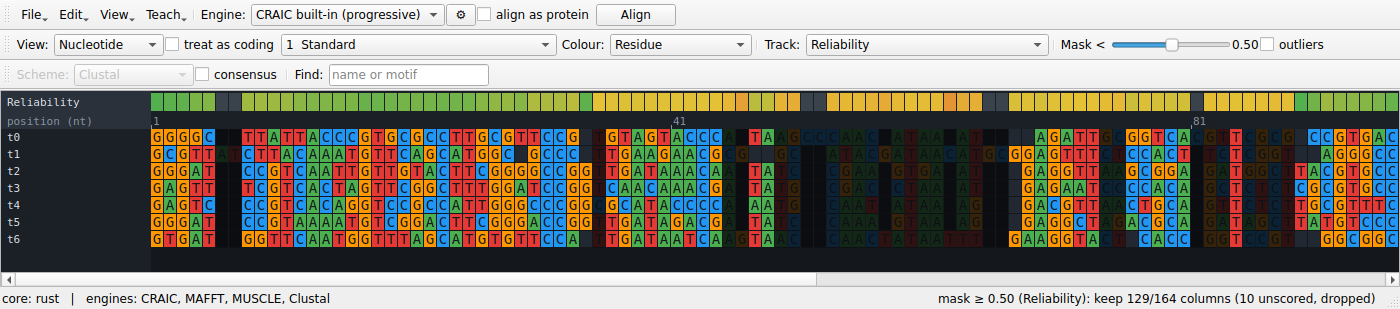
A reliability score for every column and residue, from one pair-HMM, recomputed as you edit. Preview a mask with a slider, or mask single residues by hand.
-
Compare aligners
Run MAFFT, MUSCLE, Clustal Omega, ProbCons, PRANK, ClustalW or the built-in aligner, with their settings exposed, and colour each column by how often they agree.
-
Realign one region
Select a block, realign it several ways, compare the alternatives side by side, and splice the best back in without disturbing the rest.
-
Look inside the model
The posterior explorer shows the alternative ways a residue could align, not just the one the aligner chose.
-
Teach with a known answer
Simulate sequences whose true alignment is known, align them, and see exactly which residues each aligner, or each student, got wrong.
-
Script it
craic score,mask,align,trimandsimulaterun headless, on a laptop, a cluster node or in a pipeline.
Nucleotides, codons and amino acids come from one representation, so you can align at one level and read the result at another.
Does the reliability score work?
On BAliBASE 3 and on simulations with a known answer, the score picks out misaligned columns well. Deleting the columns it flags still makes trees worse, and so does masking the flagged residues, so CRAIC is built for inspecting and curating an alignment rather than filtering it automatically. The evidence is in Validation, and what the score cannot do is in Limitations.
Wondering why this exists when you already have an alignment viewer? Read Background & intent. Wondering how it works? Read Concepts & methods.
Citing CRAIC
If you use CRAIC, please cite
McInerney J. 2026. CRAIC: interactive interrogation of multiple sequence alignment uncertainty. bioRxiv preprint (link to follow).
The paper is under review; the About page has the current citation, BibTeX, and the methods to cite alongside it.
CRAIC is written by James McInerney, University of Liverpool. It is free and open source under the MIT licence; the code is on GitHub.