Ambiguity tools
CRAIC's reason for existing: four complementary, evidence-based views of where an alignment is trustworthy and where it is guessing.
1 · Reliability overlay + live masking
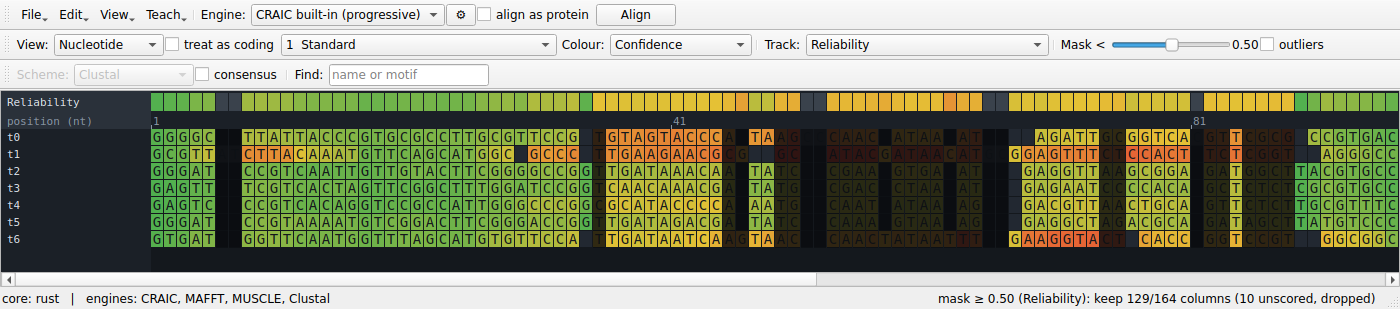
Every column and residue gets a confidence score from two independent signals: a consistency score (the pair-HMM posterior that the residues a column groups together really are homologous) and a perturbation score (how many of a residue's asserted homologies survive re-alignment under perturbed conditions). Choose Reliability from the Track dropdown (it computes on first use), then read it on the track, as Confidence colouring, or as a live mask preview via the Mask slider. To keep the columns and drop only the unreliable residues in them, use Mask residues below the threshold (Edit ▸ Edit alignment) — see residue masks.
2 · Multi-aligner disagreement map
Choose Aligner agreement from the Track dropdown to run several engines (or gap regimes of the built-in aligner) and colour each column by how often the methods agree. Where they fight is where you should look — disagreement is the most honest signal of ambiguity.
3 · Local realignment sandbox
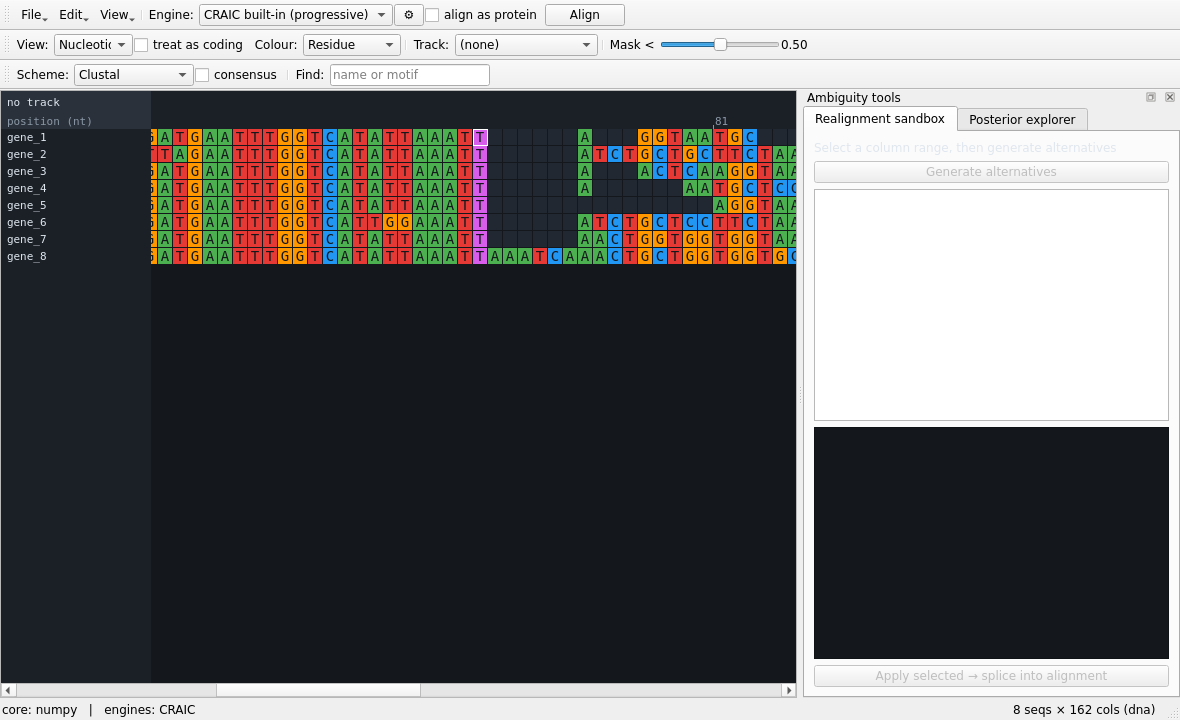
Select a hard column range, open the Realignment sandbox, and press Generate alternatives. CRAIC re-aligns just that block under different engines and gap costs, scores each, and lets you preview and splice your choice back in without disturbing the rest of the alignment.
4 · Posterior explorer
Instead of one hard column assignment, see the pair-HMM posterior for a region. Because a confident alignment is mostly a bright, boring diagonal, there are four ways to read it:
Colour by confidence — shade residues by reliability, in place.
Probe a residue — single-click any residue to paint its homology cloud: the other columns it could plausibly belong to. A tight cloud means solid homology; a spread-out one means it could slide.
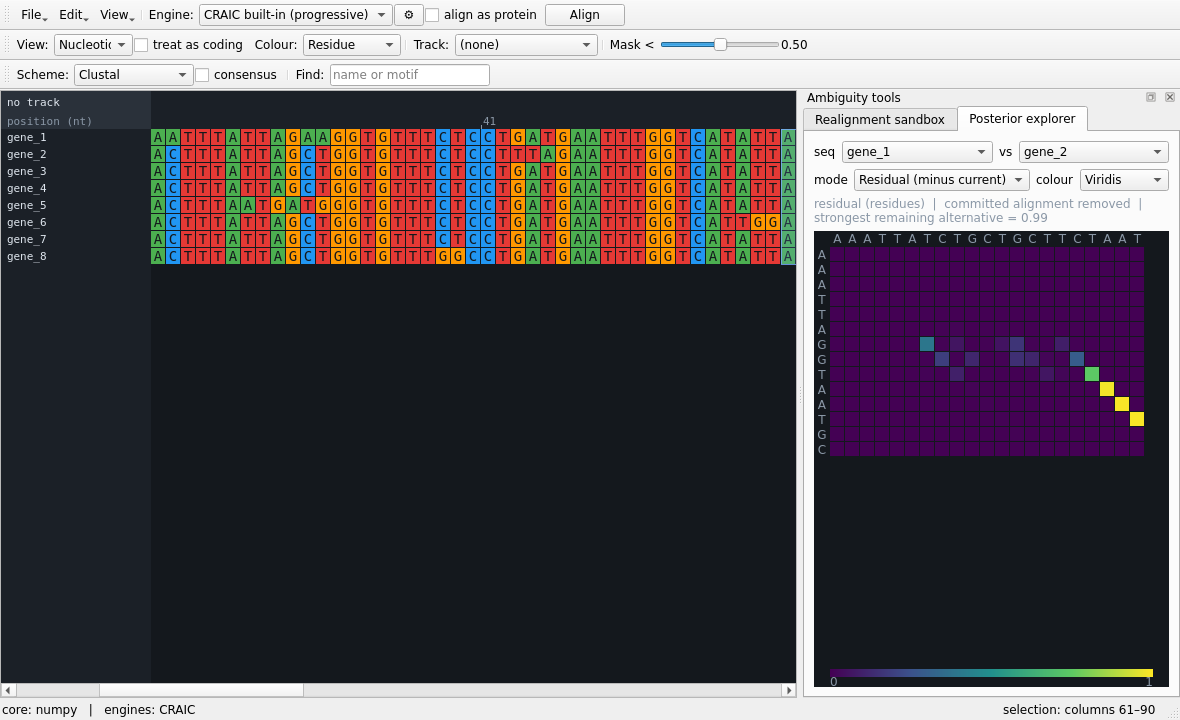
Residual mode — subtract the committed alignment so the diagonal goes dark and only the genuine alternative-homology mass remains.
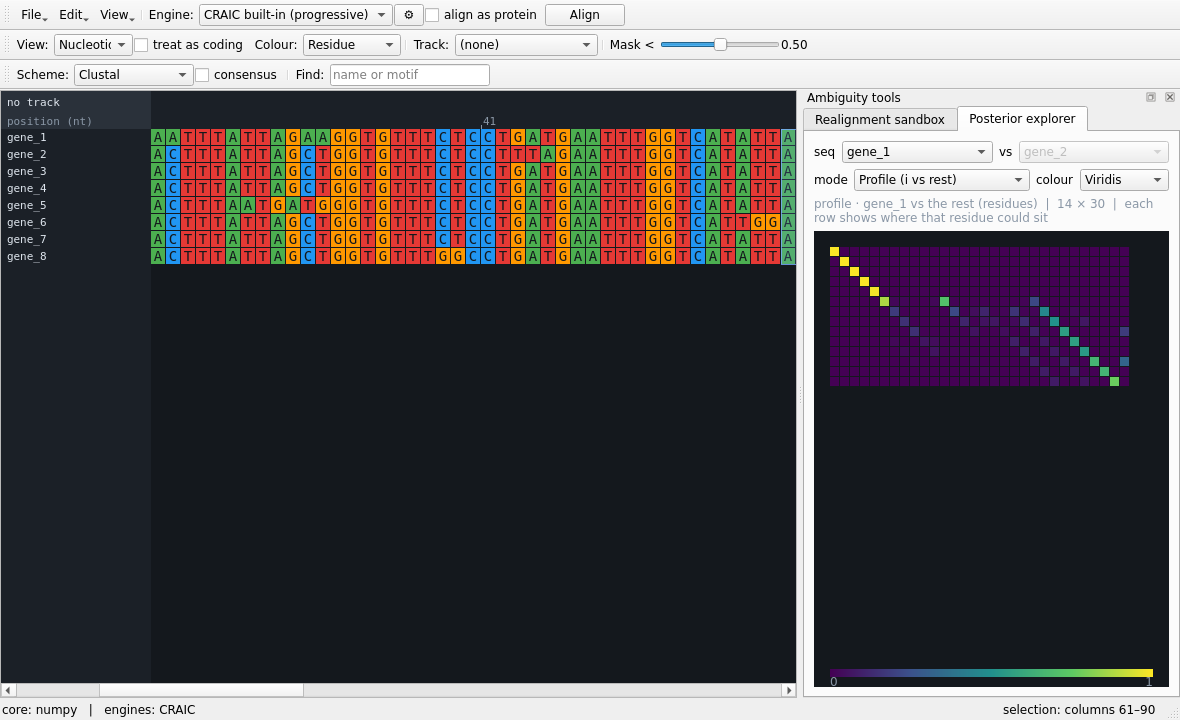
Profile mode — one sequence versus the rest, so the picture reflects the whole alignment rather than an arbitrary pair.